Digital narrative
From investigating and asking questions about a narrative, to designing and building an alternative narrative, we made an interactive game to represent the issue being explored.
Let digital media extend our organs
From investigating and asking questions about a narrative, to designing and building an alternative narrative, we made an interactive game to represent the issue being explored.

I am Chinese student of MA Digital Media from the University of Leeds. Here is my curriculum vitae, the days after coming to the UK and my interests.
Email: yangdiwen0309@gmail.com
Instagram @yangdiwenuk
Click on the upper right corner of the module below to enlarge it to start the game.
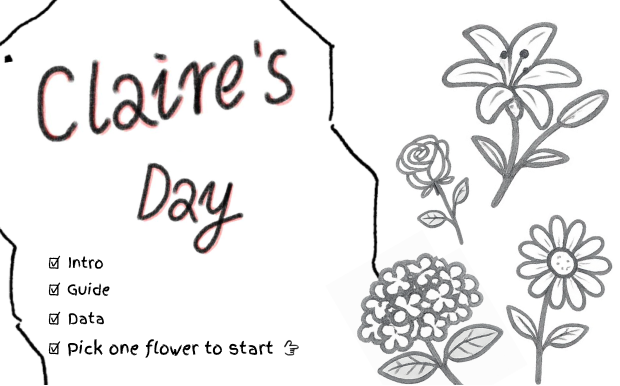
Our project, Claire’s Day, is a text-based dialogue game about gender inequality in the workplace. It engages with the theme of “Narratives & Storying” by discussing how workplace inequality is not only reflected through policies or direct visual attacks, but also through narratives, assumptions, decisions and encounters in everyday life. The project brief tells us to critically engage with a narrative and then create an alternative one to communicate a different perspective, to address a particular issue. Thus, instead of the issue being presented in the form of boring statistics, our project takes quantitative survey responses, qualitative interview data and academic literature, and turns them into an interactive fiction text where the player interacts with the story to understand how gendered labour inequality is reproduced on a daily basis.
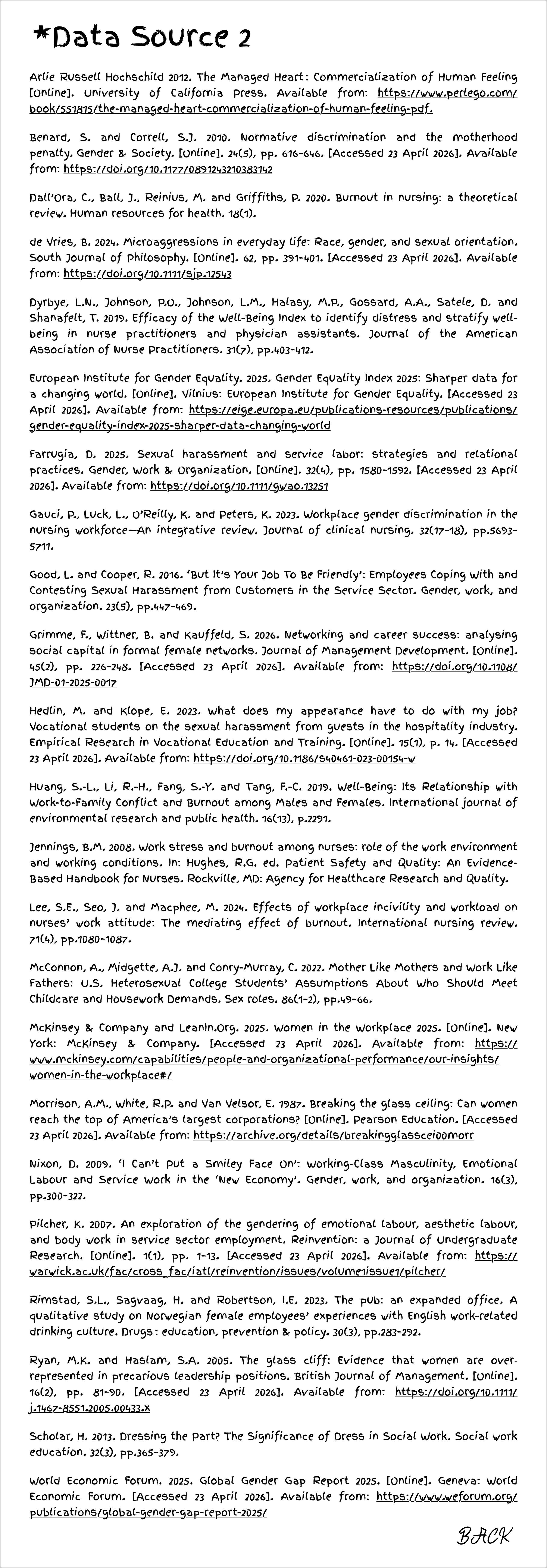
The counter-narrative we wanted to create is challenging the belief that women’s outcomes at work are simply about their individual choices, confidence, skills or aspirations. If women are not promoted, paid less, leave the workforce or stay away from certain sectors, this can be easily attributed to their choices or lack of willpower. However, we have found that this is not the whole story. Female labour market inequalities are the result of structural discrimination, social norms, workplace policies and routine interactions. Global evidence shows that gender imbalances are in fact pervasive in job promotion and remuneration. The Global Gender Gap Report 2025 of the World Economic Forum shows that the gender gap remains wide in the world, and full gender parity is over 130 years away (World Economic Forum, 2025). The ‘Women in the Workplace Report 2025’ of McKinsey and LeanIn.Org (2025) shows that women are still underrepresented in senior positions, with women representing only 29% of C-suite roles and only 93 women promoted to manager level for every 100 men. The ‘Gender Equality Index 2025’ of the European Institute for Gender Equality (2025) shows that in the European Union, women are paid only 77% of what men earn in terms of annual pay, which means women have to work 15 months and 18 days to earn what a man does in one year.
These macro patterns are significant, but our research is about the micro experience of working. Scholarship helps to understand this. Morrison, White and Van Velsor’s (1987) notion of “glass ceiling” explains what stops women from attaining senior roles. Ryan and Haslam’s (2005) notion of “glass cliff” explains that women may be appointed to leadership roles during crises. Other literature explains that they are in a “double bind”; they have to be seen as nurturing and collaborative but if they behave like that they will be viewed as ineffective, while if they are assertive and courageous, they are seen as unlikeable (Yue & King, 2021; Manzi et al., 2024). These notions were factored into our game so that players would see that women are in situations where nothing they do comes without a price.
The title "Claire's Day" conjures the notion that inequality can occur during a typical workday. The characters within the game can be categorized as a single Asian waitress in the service industry, a female field sales manager, a young nurse, and a female actuary in finance or insurance. We chose these industries based on our questionnaire results, our interviews and our access to data. Through these four characters, we depict various aspects of inequality including customer harassment, microaggressions based on race, pressure of family responsibilities, emotional labour, high barriers for promotion, exclusion by peers, and assumptions based on gender about leadership.
The final outcome of this project is an interactive, image-supported text-based game that constructs an alternative narrative around workplace gender inequality. This design draws on interactive narrative and particularly grants players full autonomy (Aarseth, 1998). While players are presented with multiple choices, each option produces different constraints rather than clear or successful outcomes. The game also incorporates some hidden surprise endings, aiming to encourage the breaking of restrictive thinking and to inspire more possibilities in life.
Furthermore, the project adopts a procedural approach to meaning-making. Rather than explicitly informing players about the existence of gender inequality, the game enables them to experience it through systems of constrained decision-making. This aligns with Bogost’s (2011) concept of procedural rhetoric, where arguments are communicated through rules, processes, and interactions rather than direct representation. In this way, the game shifts from telling to simulating inequality, allowing players to encounter its complexity firsthand.
By positioning the player in the role of Claire, the game also encourages perspective-taking and emotional engagement. This approach resonates with theories of empathy in interactive media (Belman & Flanagan, 2010), which suggest that identification with a character can deepen understanding of social issues. Through inhabiting Claire’s everyday experiences, players are invited to recognize how inequality emerges not from isolated events, but from repeated interactions and normalized expectations.
In addition to its interactive structure, the project deliberately adopts a hybrid visual-textual form. The inclusion of images alongside text enhances narrative immersion by engaging multiple sensory channels, making abstract social issues more immediate and relatable (Pink, 2015). Compared to purely text-based formats, the visual elements provide contextual cues, emotional tone, and situational clarity, supporting players in interpreting the narrative more intuitively.
The use of a hand-drawn visual style is also a conscious design choice. Hand-drawn imagery introduces a sense of subjectivity and intimacy (McCloud, 1995), reinforcing the idea that the narrative is grounded in lived experience rather than objective representation. This aesthetic aligns with approaches in visual storytelling that emphasize affect, personal voice, and interpretive openness. Rather than aiming for photorealism, the illustrations function as evocative prompts that encourage players to emotionally engage with the scenarios while leaving space for reflection.
Together, the integration of interactive narrative, procedural systems, and visual storytelling allows the project to move beyond static representation. It creates an experiential form of storytelling in which players not only observe inequality, but actively navigate its constraints, thereby gaining a more embodied understanding of its everyday manifestations.
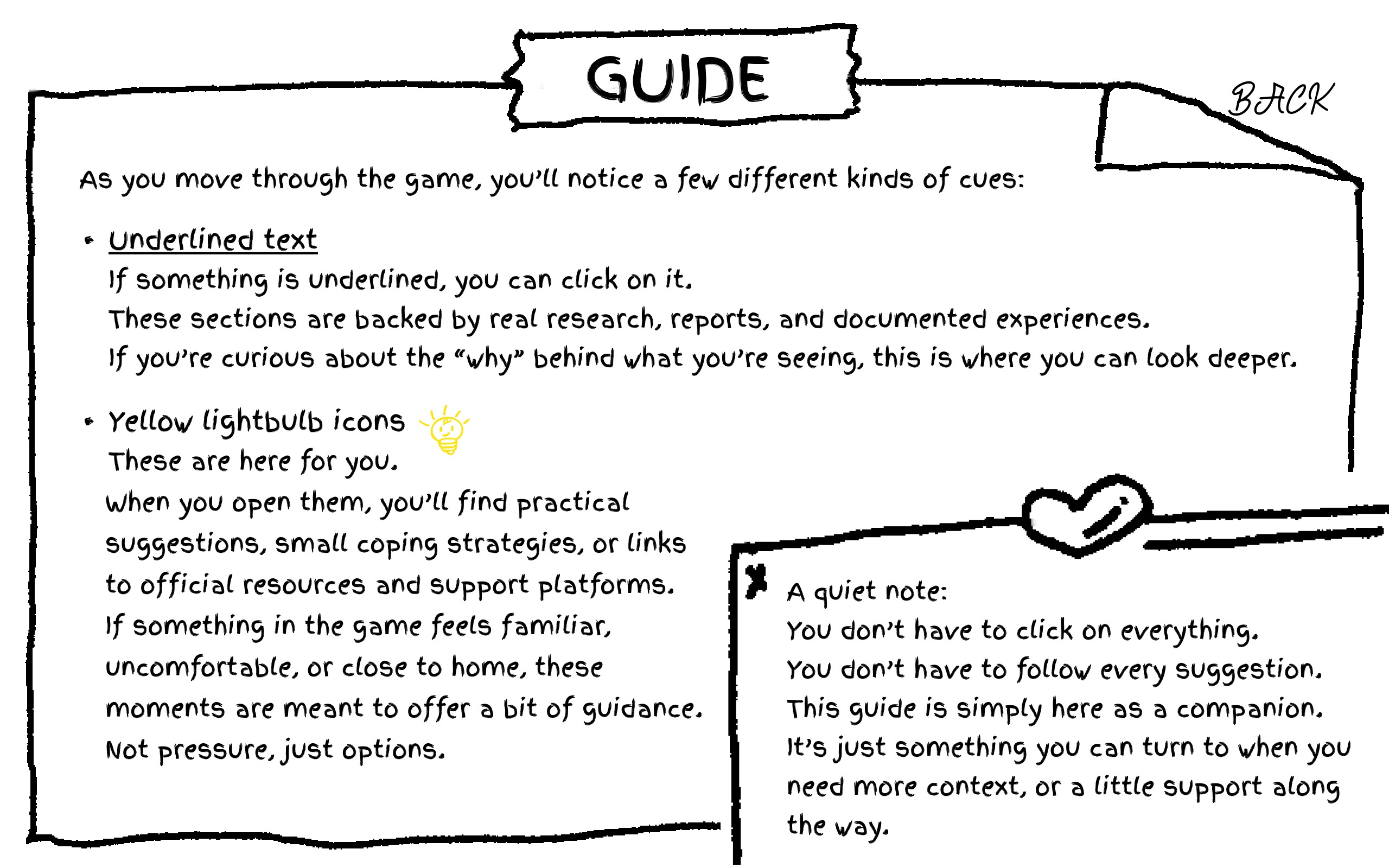
The game also contains snippets of advice and links to support services. It is vital as we do not want the project to be solely about harm. We want to promote awareness, self-protection and seeking of help. This includes documenting incidents, understanding the signs of harassment, utilising formal reporting processes, getting support from unions or organisations, and finding mental health support or knowing workplace rights.
This project adopts a mixed-methods and practice-based approach, combining research, data collection, analysis, and creative production. The overall process can be divided into four stages: secondary research, primary data collection, data analysis, and interactive design.
The first stage involved secondary research using academic databases and search engines such as Google Scholar to identify key reports, statistics, and theoretical frameworks related to workplace gender inequality. Global reports from organisations such as the World Economic Forum, McKinsey/LeanIn.Org, and the European Institute for Gender Equality were used to establish the broader socio-economic context. In addition, academic literature on concepts such as the glass ceiling, glass cliff, gender stereotyping, and workplace narratives informed the conceptual framing of the project (Morrison et al., 1987; Ryan & Haslam, 2005; Jones & Clifton, 2018; Manzi et al., 2024). This stage also informed the design of the questionnaire and interview questions.
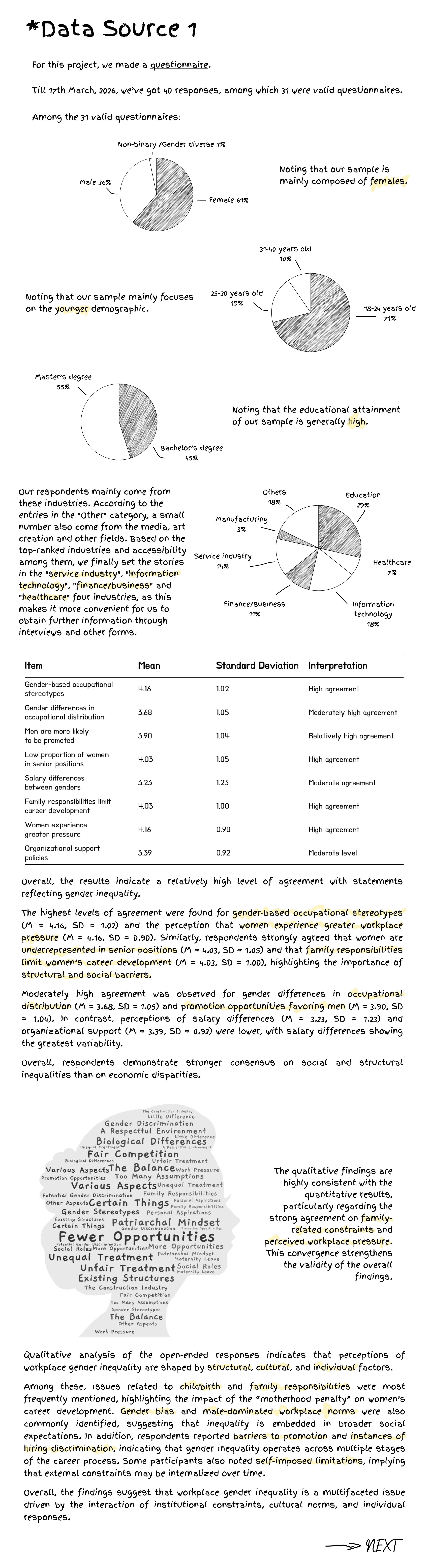
The second stage involved primary data collection through a questionnaire and semi-structured interviews. The questionnaire was designed to explore general perceptions of gender inequality across different industries. By 17 March 2026, 40 responses had been collected, of which 31 were valid. To complement the survey data, two semi-structured interviews were conducted to capture more detailed and situated workplace experiences. These interviews provided narrative depth and helped translate abstract patterns into lived experiences.
The third stage involved basic data analysis. Questionnaire results were organised and analysed using Excel, allowing for the identification of patterns, trends, and key themes. Quantitative data (such as Likert-scale responses) were used to identify areas of strong agreement, while qualitative responses were reviewed to extract recurring themes such as motherhood penalty, workplace bias, and emotional labour. These findings informed both the narrative content and the design of decision points within the game.
The final stage involved the transformation of research findings into an interactive digital artefact. Figma was used as the primary design tool to develop the structure, interface, and visual elements of the game. Also, we visualize a subset of critical data to substantiate the rationality and credibility of the game content. The design process involved translating empirical findings into branching storylines, where each scenario reflects a specific form of workplace inequality identified in the research. Hand-drawn visual elements were incorporated to support storytelling and enhance emotional engagement.
While the project demonstrates a strong integration of empirical research and interactive narrative design, several limitations should be critically considered in relation to its methods, findings, and final artefact.
First, the methodological approach presents constraints in terms of scope and representativeness. The questionnaire sample is relatively small (31 valid responses) and demographically skewed towards younger, highly educated participants, with a majority of female respondents. This limits the extent to which the findings can be generalized across different age groups, industries, or socio-economic contexts. Similarly, the use of only two semi-structured interviews restricts the diversity of perspectives captured. While these qualitative accounts provide valuable depth, they cannot fully represent the complexity and variability of workplace experiences.
Second, the interpretation of data involves an inherent degree of subjectivity. The project relies on participants’ perceptions and self-reported experiences, which may not always correspond directly to structural or statistical realities. Furthermore, the process of transforming empirical data into narrative scenarios requires selective interpretation and simplification. As a result, the interactive stories presented in the game should be understood as constructed representations rather than comprehensive or neutral accounts of workplace inequality.
Third, the design of the interactive narrative raises important questions regarding player agency and engagement. While the game intentionally limits the possibility of “optimal” outcomes in order to reflect structural constraints, this design choice may also lead some players to experience frustration or perceive the interactions as overly deterministic. This highlights a tension between accurately representing systemic inequality and maintaining a sense of meaningful agency within gameplay. In this sense, the project both utilises and problematises the concept of player agency, demonstrating how choice can exist without genuine freedom.
In addition, there is a potential risk in the way workplace experiences are represented. Although the project aims to challenge dominant narratives, the selection of specific scenarios and character types may unintentionally reproduce familiar patterns or stereotypes. The need to condense complex social dynamics into relatively short narrative branches may also lead to oversimplification, reducing the nuance of certain issues.
Another key limitation relates to the technical platform used for the project. The game was developed using Figma, which, while effective for prototyping and visual design, does not support more advanced interactive features such as audio integration, animation, or dynamic feedback systems. As a result, the experience remains largely visual and text-based, limiting its capacity for multisensory engagement. Although the use of hand-drawn visuals helps to introduce a degree of emotional and aesthetic depth, the overall experience remains less immersive than it might be in a more fully developed interactive environment.
Finally, the absence of systematic user testing limits the evaluation of the project’s effectiveness. Without structured feedback, it is difficult to determine how players interpret the scenarios, whether they recognize the intended critique of structural inequality, or how they emotionally respond to the constrained decision-making process.
Despite these limitations, the project demonstrates the value of combining research and practice in digital media. By translating empirical findings into an interactive narrative form, it offers an experiential approach to understanding workplace inequality. The use of constrained choices, visual storytelling, and branching scenarios allows the project to move beyond static representation, enabling users to engage with the complexity of social issues in a more embodied way.
Future development could address these limitations by expanding the dataset, incorporating a wider range of perspectives, and conducting user testing to refine both narrative clarity and user experience. In addition, adopting more advanced interactive platforms would allow for the integration of audio, animation, and responsive systems, further enhancing immersion and emotional engagement. Such developments would strengthen the project’s capacity to communicate complex social realities through interactive storytelling.
Previous Works
Course reflection
View my curriculum vitae
Days in the UK
My hobbies